
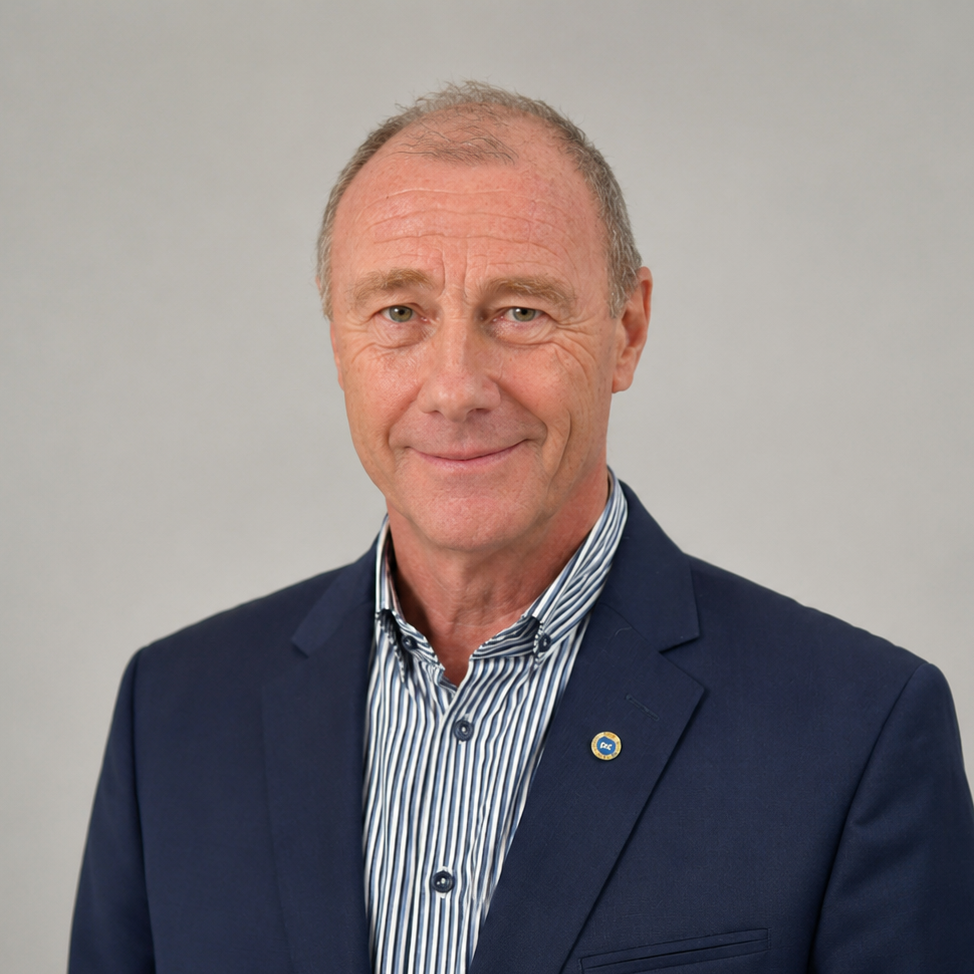

Professor Sabin Stoica currently serves as Senior Scientist and Director of the Centre International de Formation et de Recherche Avancées en Physique, CIFRA, and as professor at the Doctoral School of the Faculty of Physics, University of Bucharest.
His research activity includes significant contributions to atomic, nuclear and high-energy physics, covering double-beta decay, particle physics, neutrino physics and phenomena beyond the Standard Model. His academic output includes approximately 500 articles published in leading journals such as Nature, Nature Physics, Progress in Nuclear and Particle Physics and Physical Review Letters, gathering around 25,000 independent citations.
Throughout his career, he has held numerous leadership roles in Romanian and international scientific communities. He served as Head of the Theoretical Physics Department and Director of the Centre of Excellence in Nuclear Physics at IFIN-HH, Romanian team leader in the LHCb experiment at CERN, and member of the boards of the LHCb-CERN and DUNE-Fermilab experiments. He has also been a visiting professor at the Max Planck Institute for Nuclear Physics in Heidelberg and the University of São Paulo.
His scientific excellence has been recognized through several distinctions, including the Romanian Academy Award in 1996, a nomination for the UNESCO-Russia Mendeleev Prize in 2021, the Research Award in 2022 and a special volume dedicated to his work by the journals Universe and Symmetry.
Professor Stoica also has extensive UNESCO-related activity. He directs CIFRA, a Category 2 UNESCO Centre, previously held the UNESCO Chair “Sustainable Development through Research and Education in Modern Physics,” served on the Board of UNESCO’s International Basic Sciences Programme, coordinated the UNESCO Microscience Global Experiments initiative and currently serves on the Editorial Board of the UNESCO Science Report 2026. He also involved CIFRA as a founding institution of the UNESCO SCIENSA network.
At FACTORY 4.0, Professor Sabin Stoica will join Panel 5, “Quantum Computing & Communication: Securing the Industrial Future,” where he will contribute a scientific perspective on advanced physics, quantum technologies, international research cooperation and the role of fundamental science in shaping secure future technologies.
Meet Sabin Stoica at FACTORY 4.0
Discover how advanced physics, quantum research and international scientific collaboration can contribute to secure and transformative technologies.